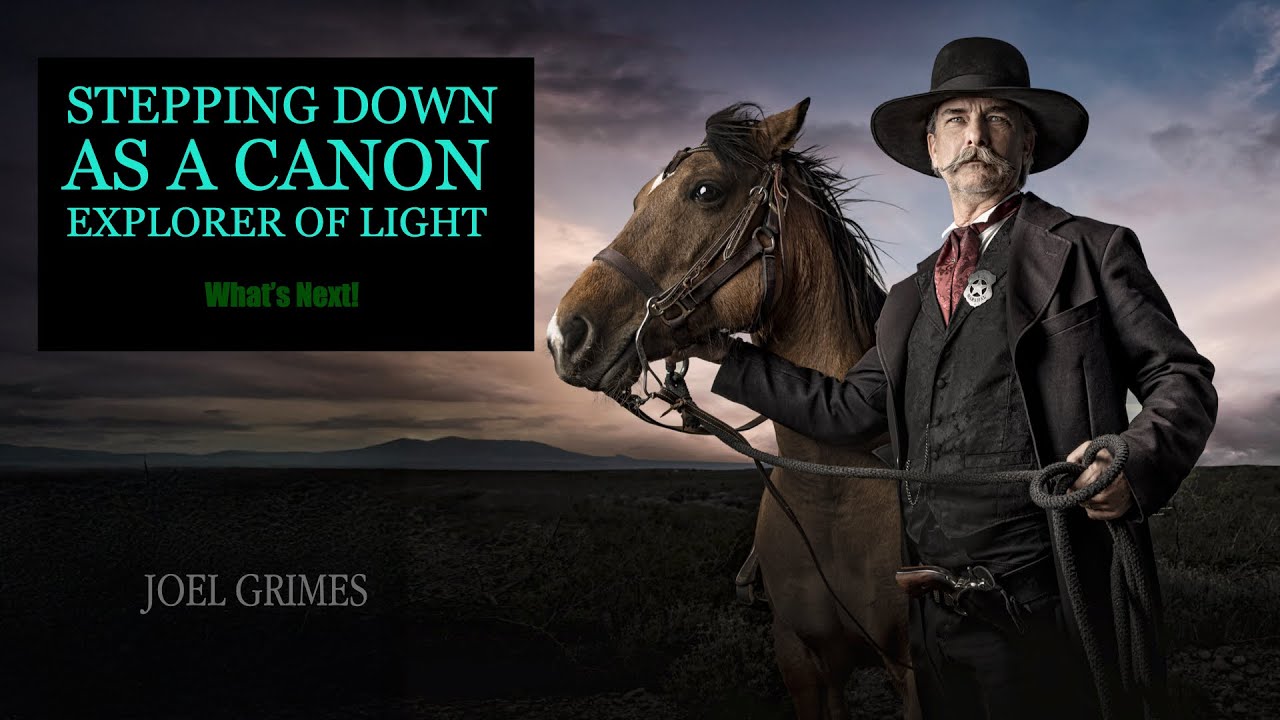
There’s a question I get asked constantly in my DMs: “Should I reach out to a camera brand? How do I become an ambassador?” I used to answer with logistics, talking about follower counts and engagement rates and the right email format. But after watching Joel Grimes walk through his decision to step down as a Canon Explorer of Light after a decade in that role, I think the more important answer starts somewhere else entirely. It starts with knowing what you actually want from your career before you tie yourself to anyone else’s brand.
In this Joel Grimes Photography tutorial, Joel doesn’t teach a lighting technique or a Photoshop workflow. He teaches something harder: how to look at your own career honestly, how to audit your goals as your life changes, and how to make strategic decisions that protect your creative freedom. For photographers at any stage, whether you’re a beginner still figuring out your niche or someone mid-career wondering why everything feels a little stuck, this one is worth your full attention.
I started teaching photography after a stranger at a coffee shop saw a shot on my phone screen and asked how I got it. That conversation reminded me that the most useful thing I can do isn’t just explain camera settings. It’s help people think about the bigger picture. Joel does exactly that in this video, and I want to break down the framework he shares so you can actually apply it to your own situation.
Step 1: Acknowledge When a Chapter Is Ending
 Joel introducing himself and his Canon Explorer of Light role
Joel opens by stating plainly that he is no longer a Canon Explorer of Light after ten years in that position. He doesn’t bury the news or spin it defensively. He names it directly, which is itself a lesson. One of the hardest things in any creative career is admitting that something has run its course, even something genuinely good.
Joel introducing himself and his Canon Explorer of Light role
Joel opens by stating plainly that he is no longer a Canon Explorer of Light after ten years in that position. He doesn’t bury the news or spin it defensively. He names it directly, which is itself a lesson. One of the hardest things in any creative career is admitting that something has run its course, even something genuinely good.
If you’re holding onto a creative partnership, a client relationship, or even a shooting style because it used to serve you well, Joel’s willingness to simply say “this chapter is done” is a model worth studying. Clarity is a career skill.
Step 2: Reframe Endings as Transitions, Not Failures
 Joel explaining the Canon Legends category
Rather than treating his departure as a loss, Joel explains that Canon has moved him into a new category called Canon Legends, a designation for photographers who have moved on from the active Explorer role. He still maintains some connection to the brand and views the title with genuine warmth.
Joel explaining the Canon Legends category
Rather than treating his departure as a loss, Joel explains that Canon has moved him into a new category called Canon Legends, a designation for photographers who have moved on from the active Explorer role. He still maintains some connection to the brand and views the title with genuine warmth.
The practical takeaway here is about how you narrate transitions to yourself and to your audience. If you stop working with a sponsor, drop a service offering, or pivot your focus, the story you tell matters. Joel frames this as a natural evolution rather than a rejection, and that framing is honest and strategically sound. People respect photographers who evolve with intention.
Step 3: Let Your Age and Timeline Inform Your Priorities
 Joel discussing turning 67 and thinking about the next 10 years
Joel is open about being 67 years old and thinking seriously about what he wants to accomplish in the next decade. He describes a shift in thinking that comes with age: suddenly the window of time for certain projects feels finite, and that changes what deserves your energy.
Joel discussing turning 67 and thinking about the next 10 years
Joel is open about being 67 years old and thinking seriously about what he wants to accomplish in the next decade. He describes a shift in thinking that comes with age: suddenly the window of time for certain projects feels finite, and that changes what deserves your energy.
You don’t have to be in your sixties for this to apply. I’m 31, and I already think about this on my Sunday morning photo walks. The question “what do I actually want to make?” hits differently once you stop treating time as infinite. Building a career around someone else’s brand roadmap can crowd out the personal work you keep promising yourself you’ll get to eventually.
Step 4: Prioritize Personal Projects Before You Regret Not Doing So
 Joel referencing Albert Watson’s regret about personal projects
Joel mentions listening to an interview with photographer Albert Watson, one of his living heroes, and being struck by Watson’s single regret: not doing more personal projects. Joel connects this directly to his own decision. His next chapter is built around fine art work, images he wants to hang in galleries, work that exists for its own sake rather than a client brief or a brand deliverable.
Joel referencing Albert Watson’s regret about personal projects
Joel mentions listening to an interview with photographer Albert Watson, one of his living heroes, and being struck by Watson’s single regret: not doing more personal projects. Joel connects this directly to his own decision. His next chapter is built around fine art work, images he wants to hang in galleries, work that exists for its own sake rather than a client brief or a brand deliverable.
This is a concrete prompt you can use right now. Write down three personal photography projects you’ve been meaning to start. Not client work, not content for social media, not a challenge someone else invented. Projects that matter to you. Then look at your current schedule and ask honestly whether your commitments leave room for them.
Step 5: Understand What Brand Partnerships Actually Cost
 Joel beginning to address why he stepped down and what it means for influencers
Joel begins shifting into direct advice for photographers who want to pursue brand ambassador or influencer roles tied to camera companies. He’s careful here, and you should be too. Brand partnerships come with constraints. You represent a product, which shapes what you can say, what gear you can be seen using, and sometimes even what projects feel appropriate to pursue publicly.
Joel beginning to address why he stepped down and what it means for influencers
Joel begins shifting into direct advice for photographers who want to pursue brand ambassador or influencer roles tied to camera companies. He’s careful here, and you should be too. Brand partnerships come with constraints. You represent a product, which shapes what you can say, what gear you can be seen using, and sometimes even what projects feel appropriate to pursue publicly.
This isn’t a reason to avoid partnerships. Joel spent ten years as a Canon Explorer of Light and describes it as a genuine blessing. But it is a reason to go in with open eyes. Before you pitch yourself to any brand, ask: what would I have to stop doing or saying to hold this relationship? Is that trade worth it at this stage of my career?
Step 6: Set a 10-Year Vision, Not Just a Next-Step Plan
 Joel describing his contract ending and thinking about the next 10 years
When Joel’s contract came up for renewal, he didn’t just ask “should I renew?” He asked what he wanted the next ten years to look like and worked backward from there. That longer horizon changed the answer.
Joel describing his contract ending and thinking about the next 10 years
When Joel’s contract came up for renewal, he didn’t just ask “should I renew?” He asked what he wanted the next ten years to look like and worked backward from there. That longer horizon changed the answer.
Most photographers I talk to are planning six months out at most. Which clients to pitch, which workshops to attend, which gear to upgrade. A ten-year question forces different thinking. Where do you want your work to live? In editorial spreads, gallery walls, licensing catalogs, textbooks? The answer shapes every smaller decision.
What I’d Add From My Own Experience
Joel’s framework is built on decades of commercial advertising work, a career of genuine weight. My path has been different, scrappier in some ways, more platform-native in others. But the core tension he describes is one I’ve felt even at my scale: the pull between building something for an audience and building something for yourself.
My advice is to keep at least one project running at all times that has no deliverable attached to it. No posting schedule, no brand tag, no metric. Just work you’re making because you want to see it exist. It doesn’t have to be grand. Mine right now is a slow series of portraits from my Sunday photo walks, no editing beyond a basic grade, no plan to publish them. But having that work in progress reminds me why I picked up a camera in the first place, and that reminder keeps everything else sharper.
The single most important thing Joel says in this video is also the simplest: as your life changes, your goals should change too, and that’s not weakness, it’s wisdom. A brand, a title, or a partnership that was right for you at 45 might not be right at 67. The photographers who stay creatively alive are the ones who keep asking the question rather than assuming the answer stays the same.
Watch the full tutorial on YouTube and give it the full sit-down watch it deserves. Joel is one of the most honest voices in this industry, and this one is worth more than just a skim.
Comments (2)
Quality content like this is rare. Keep it up.
Tried this technique this morning. Game changer for real.
Leave a Comment