There’s a version of photography culture that feels like a competition. Whose gear is better, whose edit is cleaner, whose follower count is climbing faster. I spent my first couple of years shooting in that headspace, quietly comparing myself to everyone and saying very little to the people around me. What changed things wasn’t a new lens or a Lightroom preset. It was a stranger at a coffee shop asking how I got a particular shot, and me actually sitting down and explaining it. That conversation reminded me that knowledge shared doesn’t shrink. It multiplies.
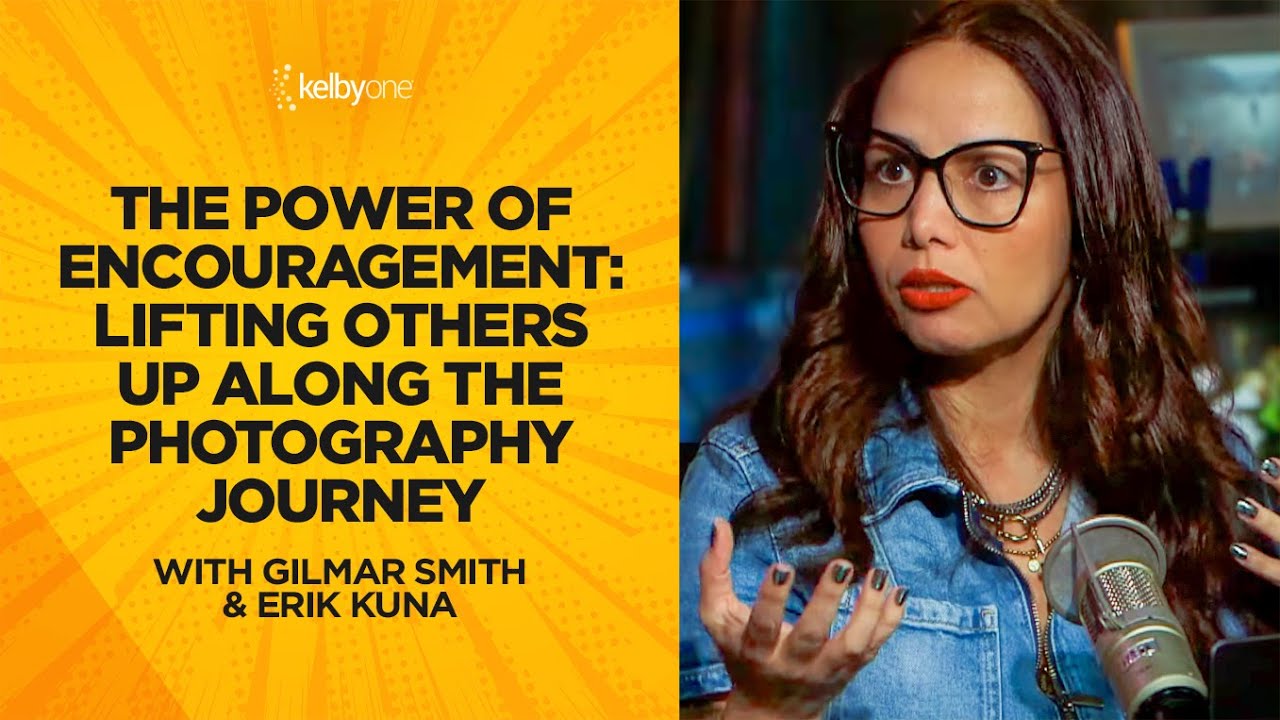
In this KelbyOne tutorial, Watch the full tutorial on YouTube, two photographers reflect honestly on how encouragement from mentors and peers shaped their entire careers. It’s not a technical video. There are no sliders to drag or histograms to read. But I’d argue the lesson here is more foundational than anything in a Lightroom panel, because it shapes how you show up in the communities where your growth actually happens.
If you’ve ever hesitated to comment on someone’s photo, wondered whether your feedback would matter, or felt like you had nothing worth offering newer shooters, this one’s worth a close read.
Step 1: Recognize That Encouragement Functions as a Force Multiplier
 Speaker explaining encouragement as a force multiplier concept
The first move the tutorial makes is reframing encouragement not as a soft, optional kindness but as something with real strategic weight. The idea is that tearing people down is easy and almost automatic, while genuine encouragement takes intention. When you apply that intention consistently, the effect compounds across a community.
Speaker explaining encouragement as a force multiplier concept
The first move the tutorial makes is reframing encouragement not as a soft, optional kindness but as something with real strategic weight. The idea is that tearing people down is easy and almost automatic, while genuine encouragement takes intention. When you apply that intention consistently, the effect compounds across a community.
Think about your own Sunday morning photo walks, or wherever you shoot regularly. Every person you interact with is either going to walk away feeling a little more confident or a little less. That’s not dramatic, it’s just how human beings work. Deciding to be the person who adds to someone’s confidence rather than quietly subtracts from it is the first and most important decision in this whole framework.
Step 2: Reflect on Who Lifted You Up Early
 Photographer recounting early community support during Google Plus era
The tutorial gets specific here by having both speakers trace their own paths back to the people who believed in them before they believed in themselves. One of them credits a mentor who spotted potential he hadn’t recognized in his own work. That recognition didn’t come from a formal critique session. It came from someone in an online photography community who simply took the time to say, “I see something real here.”
Photographer recounting early community support during Google Plus era
The tutorial gets specific here by having both speakers trace their own paths back to the people who believed in them before they believed in themselves. One of them credits a mentor who spotted potential he hadn’t recognized in his own work. That recognition didn’t come from a formal critique session. It came from someone in an online photography community who simply took the time to say, “I see something real here.”
This step is worth doing yourself, even just as a mental exercise. Who was the first person who made you feel like your photography was worth continuing? What did they say, exactly? Chances are it was something fairly small. A comment. A message. A word during a workshop. The point is that it stuck, which means the words you send out into your own community are sticking too, whether you’re paying attention to that or not.
Step 3: Understand What Specific Encouragement Actually Sounds Like
 Discussion of specific phrases that encourage rather than generic praise
Generic praise is almost useless. “Nice photo” lands and disappears. What actually moves people is specific, directional feedback. The tutorial gives a simple example: instead of broad approval, try naming the specific element that’s working. The composition. The light. The moment that was caught. Even if the overall image isn’t polished, pointing to one thing that’s genuinely strong gives the photographer something to build on.
Discussion of specific phrases that encourage rather than generic praise
Generic praise is almost useless. “Nice photo” lands and disappears. What actually moves people is specific, directional feedback. The tutorial gives a simple example: instead of broad approval, try naming the specific element that’s working. The composition. The light. The moment that was caught. Even if the overall image isn’t polished, pointing to one thing that’s genuinely strong gives the photographer something to build on.
In practice, this means slowing down when you’re scrolling through a community group or looking at a friend’s recent work. Instead of double-tapping and moving on, ask yourself what is actually working in this image. Then say that thing out loud, in a comment or a message. It takes maybe thirty extra seconds and it can change the trajectory of someone’s whole week. I know because it changed mine.
Step 4: Redefine Strength as the Capacity to Lift Others
 Speaker explaining “gentle” as strength used to elevate others
This is the part of the tutorial I found most useful to sit with. There’s a concept discussed here that reframes what it means to be skilled in your craft. Mastery isn’t the finish line where you finally get to stop worrying about everyone else. Mastery gives you more to offer. The time and money and practice you’ve poured into your photography is most powerful when you turn it outward.
Speaker explaining “gentle” as strength used to elevate others
This is the part of the tutorial I found most useful to sit with. There’s a concept discussed here that reframes what it means to be skilled in your craft. Mastery isn’t the finish line where you finally get to stop worrying about everyone else. Mastery gives you more to offer. The time and money and practice you’ve poured into your photography is most powerful when you turn it outward.
That’s not a fluffy idea. It’s a practical reorientation. Every time you’ve stayed up watching tutorials, every workshop you’ve attended, every hour you’ve spent walking the same block trying to nail the light, you were building a resource. The question is whether that resource stays inside your own body of work or gets distributed to the people coming up behind you.
Step 5: Make Encouragement a Deliberate Weekly Practice
 Call to action encouraging viewer to actively encourage someone this week
The tutorial closes with a direct, low-stakes challenge: go find someone’s work this week and tell them what you see in it. Not a critique. Not a comparison. Just an honest, specific observation about what they’re doing well.
Call to action encouraging viewer to actively encourage someone this week
The tutorial closes with a direct, low-stakes challenge: go find someone’s work this week and tell them what you see in it. Not a critique. Not a comparison. Just an honest, specific observation about what they’re doing well.
This is the kind of thing that sounds minor until you build it into a habit. Pick one photographer in a community you’re part of, whether that’s a Facebook group, an Instagram thread, a local camera club, or even just a friend who texts you their photos. Look at their recent work carefully and respond with one specific thing that’s landing. Do that every week for a month and watch how the dynamic in that community starts to shift.
My Own Take: Encouragement Works Best When It’s Consistent, Not Occasional
I’ve noticed in my own experience that encouragement has the most impact when it’s not reserved for exceptional work. If you only speak up when someone nails a technically flawless shot, you’re training the people around you to believe that effort only counts when it produces perfection. But photography is mostly a practice of imperfect attempts that slowly get better.
Some of my most meaningful creative conversations have started because I commented on something that was almost there, something with one strong element and a lot of room to grow. That person knew their photo wasn’t perfect. What they needed to hear was that one thing they were doing right, so they’d know to keep doing it. That’s what pushes people past the plateau.
The single most important takeaway from this tutorial is simple: the skill you’ve built in photography is more valuable when you share it. Not just by posting your own work, but by actively recognizing what’s working in someone else’s. That habit of specific, generous attention is what healthy photography communities are built from, and it costs you nothing.
Watch the full tutorial on YouTube and spend fifteen minutes with it. Then go find one photographer this week and tell them what you see.
Comments (2)
The before and after really sells it. Incredible difference.
Couldn't agree more. I've seen this make a huge difference in photoshop work specifically.
Leave a Comment