I’ve been thinking a lot lately about what it actually means to commit to a shot.
Not in the motivational-poster sense. I mean the physical, logistical, you-burned-your-dinner kind of commitment. Last month I was out on my Sunday morning photo walk and I kept chimping, checking the back of my camera every thirty seconds, second-guessing my focus point, re-shooting the same frame six or seven times. I got home with 200 photos and maybe two that felt intentional. The rest were noise. That’s when I went back and watched a tutorial I’d bookmarked months ago and finally sat with it properly.
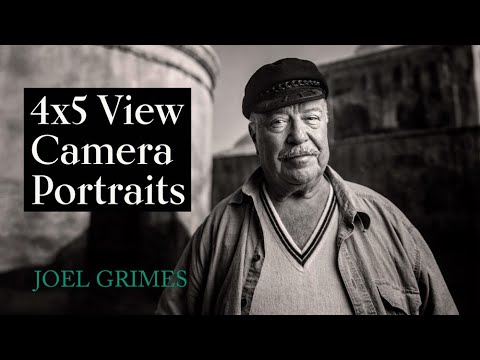
In this Joel Grimes tutorial, the award-winning commercial photographer takes you inside his 1990s workflow, back when he was shooting large-format portraits on a 4x5 view camera using Polaroid Type 55 positive/negative film. Over that decade he exposed more than 7,000 sheets. What struck me wasn’t the nostalgia. It was how much discipline that format demanded, and how much I could steal from it for the way I shoot today.
Watch the full tutorial on YouTube
Why Large Format Forces You to Slow Down
A 4x5 view camera isn’t like anything you’d shoot with now. There’s no burst mode. No auto-anything. Every single sheet of film was a considered decision because every single sheet cost money and time. Joel explains that loading, shooting, and processing one frame could take several minutes. That pace isn’t a limitation, it’s a methodology.
When you know you only get one, maybe two attempts at a frame, you stop guessing and start solving. You check your light. You check your composition. You check your focus. Then you check it again. That’s the mindset Joel built his career on, and it’s one that translates even if you’re shooting digital with unlimited cards.
The Dual-Focus Technique That Changed How I Think About Sharpness
This is the part of the tutorial I’ve already started applying. Because 4x5 film captures so much detail, focus has to be exact. Not close. Exact. Any softness is immediately visible on a large print or transparency.
Joel developed what he calls a dual-focus technique to guarantee sharp results, especially when shooting portraits where the subject’s face needed to be critically sharp across both eyes and the nose plane. Here’s how it works:
- Set your focus on the near eye, the eye closest to the camera.
- Without moving the camera, shift focus to the far eye.
- Find the midpoint between those two focus distances and lock there.
- Adjust your aperture to give yourself enough depth of field to hold both eyes in acceptable sharpness from that midpoint.
On a view camera you also have the option of using the tilting front standard to angle the plane of focus. Joel used this to align the focal plane more closely with the angle of a subject’s face, which meant he could hold sharpness across the features without having to stop down to a tiny aperture and lose the character of his light.
For those of us shooting with modern cameras, the takeaway is this: stop focusing on one point and calling it done. Think about the plane of focus as a flat surface moving through your scene, and deliberately place that surface so it intersects with the most important parts of your subject at once.
How He Made Polaroid Type 55 Work for Him
Joel wasn’t just using the Polaroid Type 55 as a test print. He was using it as a final deliverable. Type 55 produced both a positive print and a usable negative, and his negatives from this period are what he’s discussing throughout the video. The emulsion had a particular quality, a kind of grain and tonal range, that became his visual signature.
He talks about how the film pushed him to understand light ratios more precisely. Because the latitude was narrower than modern digital sensors, he had to nail his exposure within a tighter window. His lighting setups had to be clean and intentional. No fixing it later. That constraint made him better.
If you want to borrow this discipline without buying film, try shooting in a flat-profile JPEG for a session instead of RAW. You’ll lose the safety net and start paying closer attention to your exposure in camera.
Where I’d Push Back, Just a Little
Everything Joel describes in this workflow assumes a controlled environment, usually a studio or a carefully managed location portrait session. The slow, methodical approach works beautifully when you have time to set up and your subject is patient.
I shoot a lot of travel and street work, which means I don’t always have thirty seconds to think through a focal plane, let alone two minutes to load a film holder. For fast-moving situations I’ve found that applying the principle matters more than following the exact steps. Meaning: before I lift the camera, I decide what needs to be sharp and why. That one second of intention does a surprising amount of work even when everything else is happening quickly.
The dual-focus concept also assumes a roughly flat subject plane. Shoot someone in a three-quarter profile with one shoulder closer to the camera and you’ll need to rethink your focal plane entirely. The technique is a starting point, not a formula.
The Simplest Thing to Take Away From 7,000 Sheets
Joel Grimes spent a decade making images where failure wasn’t just disappointing, it was expensive and irreversible. That pressure made him methodical, and that method is still visible in every portrait he makes today.
The best thing you can steal from this tutorial isn’t a specific technique. It’s the habit of deciding what needs to be sharp before you press the shutter, and building every other decision around that choice.
Watch the full video to see Joel walk through the actual camera setups, the film handling process, and the behind-the-scenes context that makes the technique make sense visually. Some of this genuinely needs to be seen to land.
Comments (4)
Great breakdown. The step-by-step approach really helps.
Just subscribed. If the rest of your content is this good, I'm in.
The before and after really sells it. Incredible difference.
Quality content like this is rare. Keep it up.
Leave a Comment