I’ve been thinking a lot lately about how fast I shoot. Last Sunday on my morning photo walk, I burned through 200 frames in two hours and came home with maybe four I actually liked. That ratio used to feel normal to me. Efficient, even. But the more I’ve been studying how photographers worked before digital gave us unlimited do-overs, the more I think I’ve been hiding behind the burst mode button.
That’s what made this tutorial stop me mid-scroll.
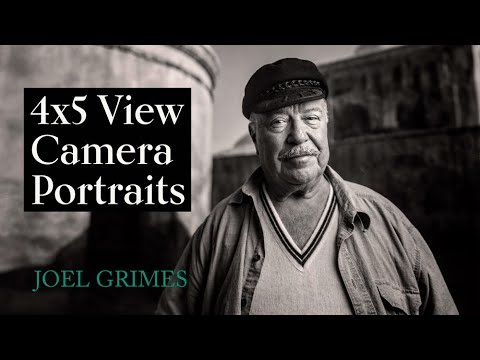
In this Joel Grimes tutorial, the award-winning commercial photographer walks through his entire workflow from the 1990s, when he spent a decade shooting portraits on a 4x5 view camera using Polaroid Type 55 positive/negative film. Over 7,000 sheets exposed. That’s not a typo. Each sheet was a deliberate, methodical decision, and the process he describes is one of the most clarifying things I’ve watched in a long time.
Why 4x5 Changes How You Think Before You Shoot
A 4x5 view camera isn’t a point-and-shoot. It isn’t even close to your DSLR. The film plane is enormous, roughly four inches by five inches, which means the physics of focus are completely different from what most of us are used to. The depth of field at any given aperture is dramatically shallower than a 35mm equivalent, which makes critical focus not just important but non-negotiable.
Grimes explains that with large-format, you’re composing on a ground glass panel at the back of the camera. The image appears upside down and backwards. You’re under a dark cloth, evaluating the scene, moving a loupe across the ground glass to check focus manually before you ever load a film holder. Every part of the process demands intention.
The practical effect of this isn’t just technical. When a single sheet of film costs real money and you can’t spray-and-pray, you look harder. You commit to your frame. You stop shooting and start seeing.
The Dual-Focus Technique That Guaranteed Sharp Portraits
Here’s the specific method Grimes developed that I found genuinely clever, and honestly something I’ve adapted into my own digital work.
Because large-format portraits involve such shallow depth of field, getting the eyes tack-sharp was a constant challenge. Grimes solved this by focusing on the near eye first, then the far eye, and splitting the difference so the focal plane landed precisely between them. He describes doing this with the loupe on the ground glass, racking the focus back and forth deliberately to find that center point where both eyes hold acceptable sharpness.
The steps he outlines look roughly like this:
- Set your composition and lock the camera position completely.
- Under the dark cloth with your loupe, focus on the eye closest to the camera. Note where that falls.
- Shift focus to the farther eye. Note that point.
- Rack the focus to the midpoint between the two.
- Stop down to your working aperture to extend the depth of field just enough to hold both eyes.
- Load the film holder and shoot.
It sounds slow. It is slow. That’s the point.
He also used Polaroid Type 55 to proof shots, which is one of the few Polaroid films that produced both a usable positive print and a recoverable negative. This let him check exposure and focus on location before committing to his actual film stock. It was a built-in feedback loop, decades before chimping became a digital habit.
What Polaroid Type 55 Actually Did for the Workflow
Grimes is specific about why Type 55 mattered beyond just proofing. The negatives it produced had a distinctive tonal quality, with fine grain and a certain luminous delicacy that he describes as unlike anything he’s worked with since. He archived these negatives and many of the portraits from that era carry a softness that feels intentional, almost painterly.
The process of pulling a Type 55 print also gave him immediate emotional feedback in the field. He could show a subject their image right there, which changed the energy of portrait sessions. People relaxed. Trust built faster. The photograph became collaborative rather than extractive.
That human element is something I think gets lost in a world where I tether to a laptop and the subject sees a full-resolution file on a 15-inch screen. There’s something intimate about handing someone a small print that’s still a little warm from processing.
Where I’d Push Back, Just Slightly
I want to be honest: not every lesson from large-format translates cleanly to modern digital portrait work, and I don’t think Grimes would argue otherwise.
The dual-focus technique is genuinely useful, but in digital photography with autofocus systems that can track an individual eye in real time, the mechanical version of this process is mostly solved. Where I think the principle still applies is in how you think about the focal plane before you shoot, not during autofocus acquisition. Asking yourself “where exactly do I want the sharpest point in this frame” before you half-press the shutter is a different mental habit than trusting the camera to decide.
I shoot with my phone sometimes specifically to remove the technical safety nets and force that kind of intentionality. The constraints teach you things the gear can’t.
The Takeaway That Actually Stuck With Me
The single thing I’m carrying out of this tutorial is this: constraint is not a limitation, it’s a design tool. Grimes didn’t shoot 7,000 sheets of 4x5 film despite the difficulty of the process. He made some of his best work because of it.
Watch the full video to see the actual images from that era and to hear Grimes walk through the feel of the process in his own words. The visual examples make the dual-focus technique click in a way that text can’t fully capture.
Comments
Leave a Comment