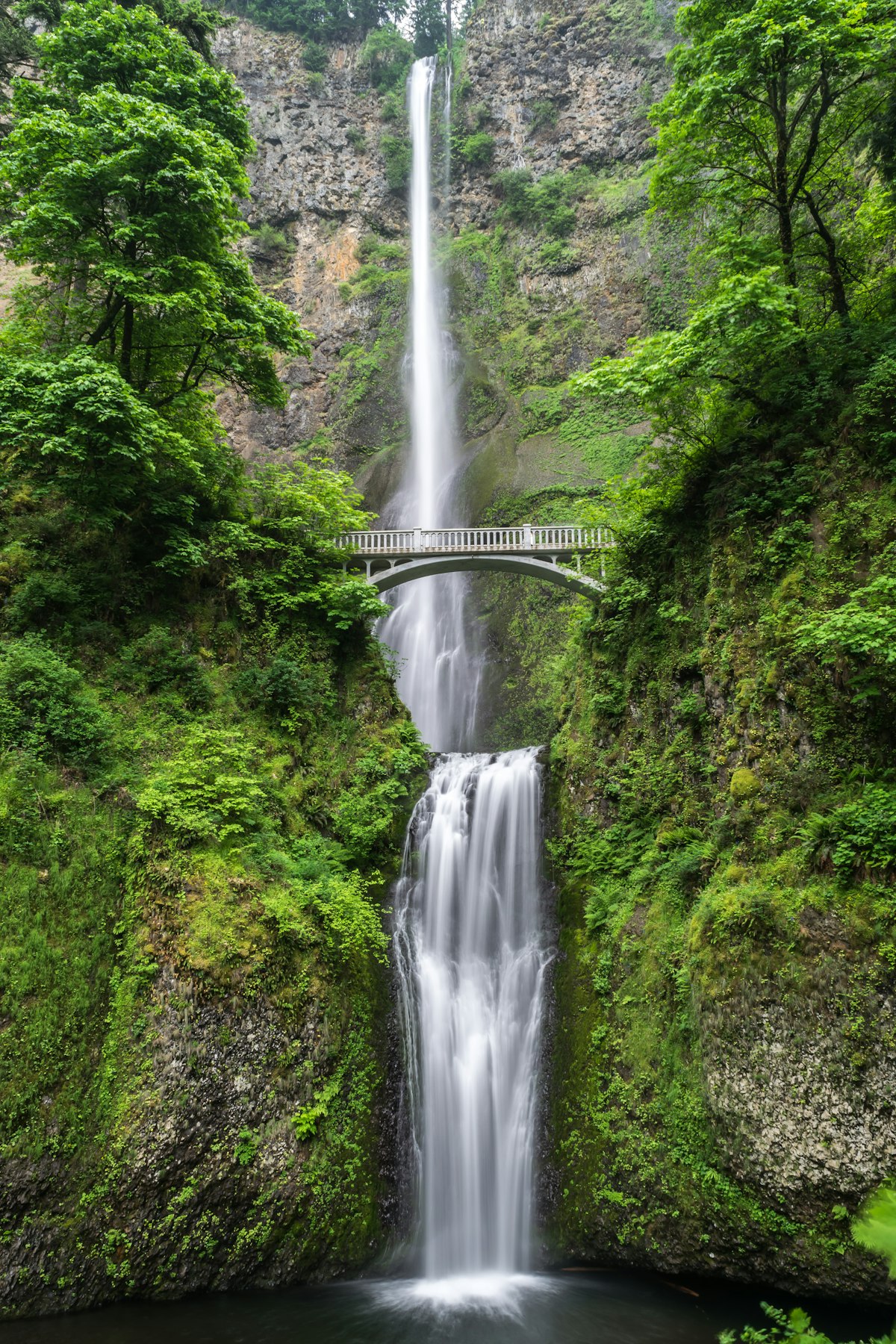
Long exposure photography — those silky waterfalls, light trails, and dreamy motion blurs — typically requires a tripod. But what if you don’t have one with you? You can still get surprisingly good results with some technique and creative problem-solving.
How Slow Can You Go Handheld?
The traditional rule of thumb: your shutter speed should be at least 1/(focal length) to avoid camera shake. At 50mm, that means 1/50 second minimum. At 200mm, 1/200 second.
But modern image stabilization has changed this. Cameras and lenses with in-body stabilization (IBIS) or optical stabilization (OIS) can give you 3-5 stops of additional handheld capability. That means:
- Without stabilization at 50mm: 1/50 second
- With good IBIS at 50mm: 1/3 to 1 second
Some newer systems claim up to 7-8 stops, though real-world results are typically 4-5 stops.
Bracing Techniques
Your body is a stabilization system. Use it properly:
The human tripod: Plant your feet shoulder-width apart. Tuck your elbows against your ribcage. Press the camera against your face (if using a viewfinder). Exhale slowly and shoot at the bottom of your breath, just like a marksman.
Lean against something: A wall, a tree, a railing — any solid surface reduces your body movement. Press your shoulder or back against it.
Use the ground: Set your camera on the ground, a rock, a wall, or a table. If the angle isn’t right, prop it with a glove, a hat, or a bag. This is essentially an improvised tripod.
The strap trick: Loop your camera strap around your neck, then push the camera forward until the strap is taut. The tension provides resistance against movement.
Camera Settings for Handheld Long Exposure
Burst mode: Take 5-10 shots in rapid succession. At least one will be sharper than the others due to natural variation in your hand movement.
Timer or remote: Use a 2-second self-timer to eliminate the shake from pressing the shutter button. This is especially important when the camera is resting on a surface.
Wider focal lengths: Wide-angle lenses are more forgiving of camera shake than telephoto lenses. If you’re trying to handhold a long exposure, zoom out.
Image stabilization: Make sure it’s turned on. If your lens and body both have stabilization, check your manual — some combinations work best with one or the other, not both.
Creative Handheld Long Exposures
Not all long exposures need to be perfectly sharp. Some of the most interesting long exposure images embrace the motion:
Intentional camera movement (ICM): Set your shutter to 1/4 to 1 second and deliberately move the camera during exposure. Pan horizontally through a forest for abstract vertical streaks. Tilt upward during a city shot for stretched lights.
Panning: Follow a moving subject with your camera during a slower exposure (1/15 to 1/60). The subject stays relatively sharp while the background blurs into motion streaks. This works beautifully for cyclists, runners, and cars.
Zoom blur: If you have a zoom lens, start at one focal length and zoom during the exposure. This creates a radial blur effect emanating from the center of the frame.
Stacking Multiple Short Exposures
Here’s a technique that mimics very long exposures without a tripod:
- Set your camera on a stable surface
- Take 20-30 shorter exposures of the same scene (each maybe 1/2 to 1 second)
- In Photoshop, load all images as layers
- Select all layers and set blend mode to “Lighten” (for light trails) or use the Statistics script for averaging (File > Scripts > Statistics > Mean)
The averaging approach simulates a single long exposure by blending many short ones. Movement gets smoothed out while static elements stay sharp.
When You Really Need a Tripod
Some shots genuinely can’t be done handheld. Exposures longer than 2-3 seconds, even with perfect stabilization and bracing, will show camera movement. Multi-minute exposures for star trails or extremely smooth water are tripod-only territory.
For everything else, the techniques above will get you remarkably close to tripod quality with nothing but good technique and stable surfaces.