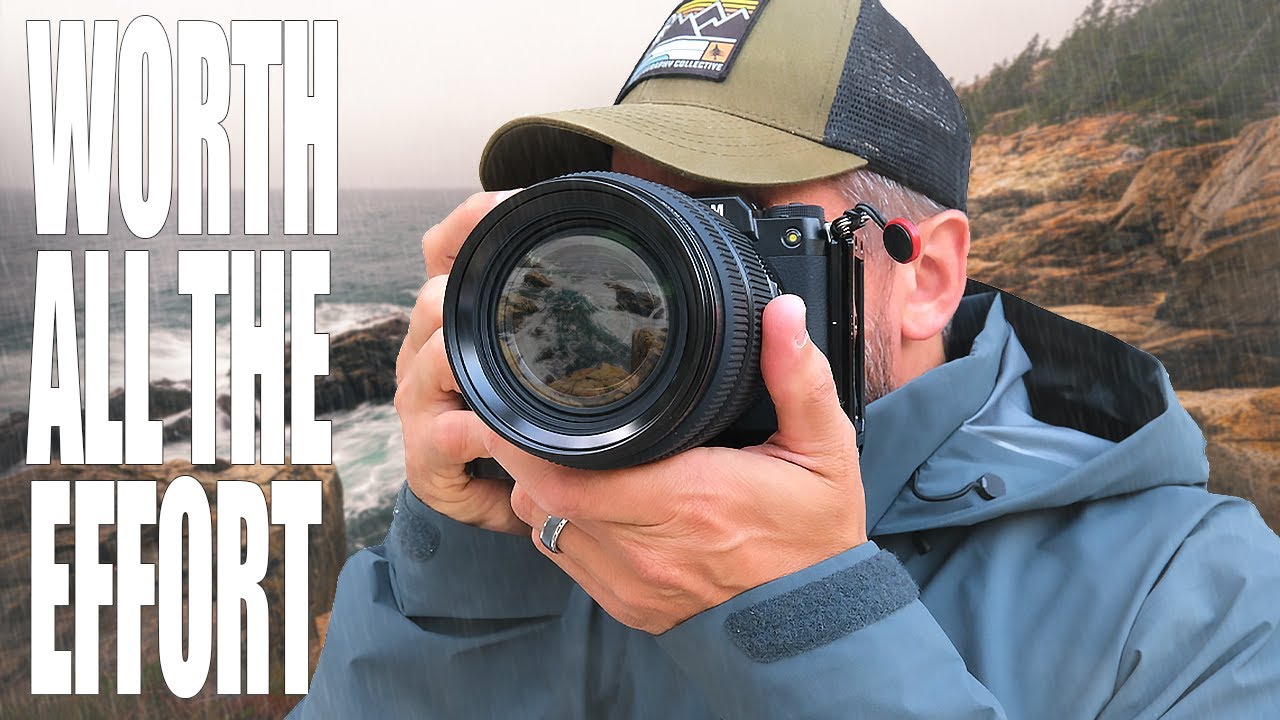
There’s a trap I fell into for years, and I didn’t even know I was in it until I looked back at a whole season’s worth of location shoots and realized I had basically taken the same photograph forty different times. Same wide composition, same sky-heavy framing, slightly different light. It felt productive in the moment because I was out there, putting in the time. But the results told a different story. If you’ve ever stood at a beautiful location and walked away with nothing you were excited about, you’ll know exactly what I mean.
Watch the full tutorial on YouTube
In this Mark Denney tutorial, he puts a name to something that took him six years to recognize in his own work: a kind of one-dimensional thinking that locks you into a single composition style and leaves you helpless when conditions don’t cooperate. The fix isn’t a new camera or a better location. It’s a shift in how you think about focal length and what “a good shot” actually looks like on any given day. Here’s how to apply what he teaches, step by step.
Step 1: Recognize When You’re Shooting on Autopilot
 Photographer standing at location repeating the same wide composition
The first move is honest self-assessment. Pull up your last ten location shots and ask yourself: do they all share the same framing style? The same sky-to-ground ratio? If your go-to answer to “what lens should I grab?” is always a wide angle, you may be on autopilot. Wide angle lenses are the standard first purchase for landscape shooters, and for good reason. They’re versatile and cinematic. But they also train your eye to default to big, sweeping frames, which only work when the sky is delivering something dramatic.
Photographer standing at location repeating the same wide composition
The first move is honest self-assessment. Pull up your last ten location shots and ask yourself: do they all share the same framing style? The same sky-to-ground ratio? If your go-to answer to “what lens should I grab?” is always a wide angle, you may be on autopilot. Wide angle lenses are the standard first purchase for landscape shooters, and for good reason. They’re versatile and cinematic. But they also train your eye to default to big, sweeping frames, which only work when the sky is delivering something dramatic.
If the sky is flat, grey, or just uninteresting, a wide composition that includes a lot of it becomes a liability, not an asset. Noticing this pattern in your own work is the first and most important step.
Step 2: Stop Waiting for Conditions to Save You
 Series of near-identical wide-angle frames with boring sky, shot in sequence
Mark describes spending entire shoots locked onto a single composition, waiting for the sky to do something. Sound familiar? I spent a whole vacation once doing this at a waterfall. I kept coming back to the same spot, same framing, missing dinner every night, convinced the light was about to get good. It wasn’t a focus problem. It was a strategy problem. I had no backup plan for the light being ordinary.
Series of near-identical wide-angle frames with boring sky, shot in sequence
Mark describes spending entire shoots locked onto a single composition, waiting for the sky to do something. Sound familiar? I spent a whole vacation once doing this at a waterfall. I kept coming back to the same spot, same framing, missing dinner every night, convinced the light was about to get good. It wasn’t a focus problem. It was a strategy problem. I had no backup plan for the light being ordinary.
The mindset shift here is this: conditions are what they are, and epic sunrises only align with your schedule occasionally. Your job is to come home with strong images regardless of what the sky decides to do. That means building a shooting approach that doesn’t require spectacular light as a prerequisite.
Step 3: Reframe What “Working the Scene” Actually Means
 Mark describing the details and distant elements he missed by staying in one spot
When you’re planted in one spot with a wide angle, you physically cannot see the rest of the scene properly. Your attention narrows. Mark talks about having “complete blinders on” to everything happening around him. Details in the middle distance, texture on the ground close by, compression opportunities in the background, all of it invisible because he’d already committed to his single frame.
Mark describing the details and distant elements he missed by staying in one spot
When you’re planted in one spot with a wide angle, you physically cannot see the rest of the scene properly. Your attention narrows. Mark talks about having “complete blinders on” to everything happening around him. Details in the middle distance, texture on the ground close by, compression opportunities in the background, all of it invisible because he’d already committed to his single frame.
Working a scene properly means walking it before you commit to anything. Move left, move right, crouch down, step back. Notice what’s 50 meters away that might compress beautifully with a longer lens. Notice the small foreground element that becomes interesting at a tighter focal length. You’re scouting, not just waiting.
Step 4: Pick Up a Telephoto or Mid-Range Lens Intentionally
 Mark discussing the goal of creating compelling images regardless of conditions
The practical tool for escaping wide-angle tunnel vision is putting a longer lens on your camera before you even start shooting. Not as a backup. As an equal first option. A 70-200mm or even a 50mm opens up a completely different vocabulary at any location. Telephoto lenses compress distance, isolate subjects, and let you exclude the sky almost entirely if you want to.
Mark discussing the goal of creating compelling images regardless of conditions
The practical tool for escaping wide-angle tunnel vision is putting a longer lens on your camera before you even start shooting. Not as a backup. As an equal first option. A 70-200mm or even a 50mm opens up a completely different vocabulary at any location. Telephoto lenses compress distance, isolate subjects, and let you exclude the sky almost entirely if you want to.
When conditions are flat, this is your path to something interesting. Look for layers in the landscape. A longer focal length will stack them up and add depth in a way that makes an ordinary scene feel deliberate and composed. The key is treating this not as your fallback option when the sky fails you, but as a legitimate primary creative choice.
Step 5: Build a Condition-Based Shooting Strategy Before You Arrive
 Mark outlining the goal of making strong images across any sky conditions
This is where the skill becomes a repeatable system rather than a lucky accident. Before heading out, look at the forecast and decide in advance which visual approach fits the expected conditions. Dramatic clouds or a colorful sunrise? Break out the wide angle and prioritize sky-heavy compositions. Overcast or clear blue sky? Plan for a telephoto-led session and focus on detail, compression, and intimacy.
Mark outlining the goal of making strong images across any sky conditions
This is where the skill becomes a repeatable system rather than a lucky accident. Before heading out, look at the forecast and decide in advance which visual approach fits the expected conditions. Dramatic clouds or a colorful sunrise? Break out the wide angle and prioritize sky-heavy compositions. Overcast or clear blue sky? Plan for a telephoto-led session and focus on detail, compression, and intimacy.
Having this decided ahead of time stops you from spending the first 20 minutes of golden hour figuring out what you’re doing. It also removes the emotional weight of feeling like the conditions “ruined” your shoot. There are no bad conditions when you have a plan for each one.
A Note From My Own Sunday Morning Walks
Every Sunday I do a photo walk through whatever neighborhood I end up in, and I made a rule for myself last year: alternate the lens every week. Wide angle one Sunday, something longer the next. What surprised me most was how much stronger my wide-angle compositions got as a result. Spending time with a telephoto forces you to look for compression, for layers, for subjects that stand on their own without epic context. When you go back to wide, you bring that eye with you. The two focal lengths don’t compete. They train each other.
If you only ever shoot wide, you only ever get good at one kind of seeing. And landscape photography is rich enough that limiting yourself to one approach means leaving a lot of great images behind, even on the exact locations you already love.
The single most important takeaway from Mark’s tutorial is this: versatility is a skill you build deliberately, and it starts with refusing to let your gear make the creative decision for you. The wide angle shouldn’t be the default. It should be one informed choice among several, picked because the conditions and composition actually call for it.
If this is a gap in your current approach, Mark breaks it down clearly and shows his own work as the before-and-after.
Watch the full tutorial on YouTube
Comments
Leave a Comment