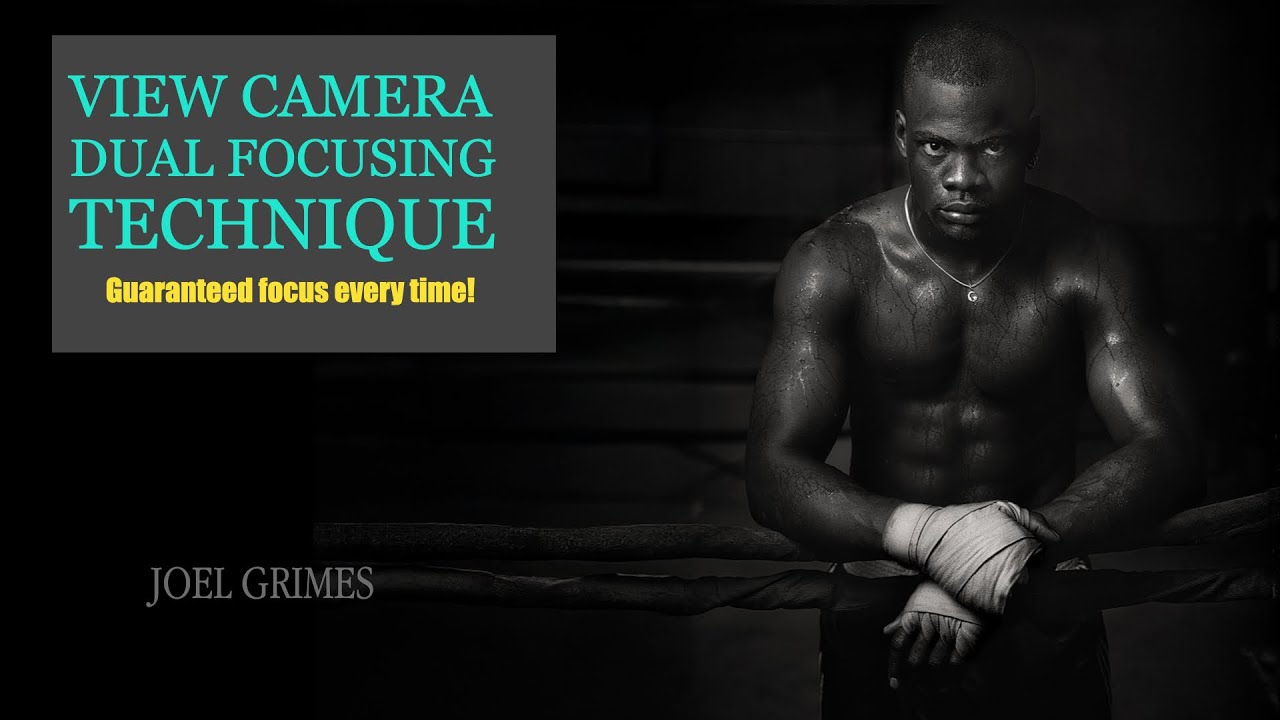
I’ve been spending more time lately revisiting film processes, partly out of curiosity and partly because a few of the photographers I really admire have been talking about large format work in a way that makes it hard to ignore. So last week I went down a rabbit hole, and somewhere in the middle of it I found a tutorial from Joel Grimes that genuinely stopped me in my tracks. Not because it was flashy, but because it solved a problem I didn’t even fully understand until he named it.
If you’ve ever tried to shoot portraits on a large format view camera, you already know the moment I mean. You’ve racked focus on the ground glass, you’ve nailed it, and then you close the lens to insert the film holder. The camera shifts. Your subject breathes. The tripod settles a millimeter. By the time you open the shutter, the focus you worked so hard for is gone, and you won’t know it until you’re in the darkroom.
The Core Problem With Standard View Camera Focusing
The ground glass on a view camera is precise, but it’s only precise in that moment. The act of closing the lens, sliding out the dark slide, and preparing to shoot introduces enough physical disruption that even a tiny shift in the camera-to-subject distance can throw off your focus plane. On a 4x5 or 8x10 shooting at a wide aperture, that tiny shift doesn’t stay tiny for long. It shows up on the negative as a portrait that’s just soft enough to be unusable.
Joel has been shooting large format portraits for over a decade. He says he hasn’t had a single out-of-focus image in that time. That’s not a boast, it’s a methodology. The dual focusing technique is the reason why.
How the Dual Focusing Technique Actually Works
The idea is straightforward, but the execution is specific. Instead of relying solely on the ground glass to confirm focus before each shot, Joel uses a secondary focusing aid that stays physically connected to the camera’s plane of focus throughout the entire process, including after the lens is closed.
Here’s how it works, step by step:
- Set up your view camera on a stable tripod and position your subject.
- Open the lens to its widest aperture and focus carefully on the ground glass using a loupe. Get it exact.
- Without moving the camera or changing the focus, note the position of your secondary focusing tool. Joel uses a device that attaches to the camera and gives a physical reference point that mirrors the current focus distance. This is your locked reference.
- Close the lens. Insert the film holder. Pull the dark slide.
- Before firing the shutter, check your secondary focusing tool to confirm the focus plane hasn’t shifted. If it has, correct it. If it matches, shoot.
The secondary focusing aid is essentially a redundant check that doesn’t require you to open the lens again. That’s the elegant part. You’re not re-focusing from scratch every time. You’re confirming that nothing has moved.
This matters more for portraits than for still life or landscape work because your subject is alive. They move. Their head tilts a centimeter between the moment you confirm focus and the moment you fire. Having a quick physical reference instead of needing to reopen and re-examine the ground glass means you can make that confirmation fast, which means less time for your subject to drift.
Where I’d Adjust This for My Own Workflow
I want to be honest here. I’m not currently shooting large format portraits on the regular. My Sunday morning photo walks are still mostly digital, and yes, sometimes my phone. But the principle Joel is working with translates further than large format film.
The underlying idea is: create a secondary confirmation system that doesn’t require you to undo your setup. I’ve started applying a looser version of this when I’m shooting tethered on location. Before I fire a shot after repositioning my subject, I check a fixed reference point in my frame (usually a mark on the floor or a piece of tape on a wall) to confirm that neither my subject nor my camera has drifted from the composition I metered and focused for. It’s a habit now. It takes two seconds and it’s saved me from more than a few selects that would have been culled.
Where this technique shows its limits is in fast-moving portrait sessions where your subject is constantly repositioning. If you’re doing editorial work or street portraiture, you can’t pause to confirm a secondary reference between every frame. Joel’s technique is built for the deliberate, methodical pace of large format work. It assumes you have time. If your session doesn’t allow for that, the technique doesn’t disappear, it just compresses. You adapt it to a mental checklist rather than a physical one.
Why the Deliberate Approach Is Worth Learning Even If You Shoot Digital
There’s a reason photographers who train on large format tend to have a different eye for preparation. When every frame costs money and time, you build systems that protect the shot before you take it, not after. Joel’s dual focusing technique is one of those systems. It’s not complicated, but it requires you to decide in advance that the check is worth doing.
That mindset, building a second confirmation into your process before committing to the exposure, is one I think about a lot when I’m teaching newer photographers. The habit of verification isn’t slowing you down. It’s the thing that makes the shot count.
Watch the full tutorial from Joel Grimes to see the technique demonstrated hands-on with the actual hardware. The visual walkthrough makes the physical setup much clearer than any written description can.
Comments
Leave a Comment