
There’s a specific kind of creative slump I fall into every few months. I’m not talking about the kind where you don’t want to pick up your camera. I’m talking about the quieter, sneakier kind where you’re still shooting, but nothing you make surprises you anymore. Everything starts to look like everything else you’ve made. The cure, almost every time, is studying someone else’s work. Not to copy it, but to let it shake something loose.
That’s exactly what Peter McKinnon’s tutorial is about. In this Watch the full tutorial on YouTube, McKinnon walks through the five Instagram accounts he actually returns to for inspiration, the ones that make him stop scrolling and ask “how did they do that?” It’s a short video, but the accounts he highlights each represent a genuinely different photographic philosophy. I want to break down what makes each one worth studying, and what you can take away as a working photographer.
My own Sunday photo walks started because I needed exactly this kind of outside input. I’d look at someone’s grid, spot a technique I’d never tried, and make it my mission for the week. That practice changed how fast I improved. These five accounts can do the same for you.
Step 1: Study Action and Motion Photography - Aaron Brimhall
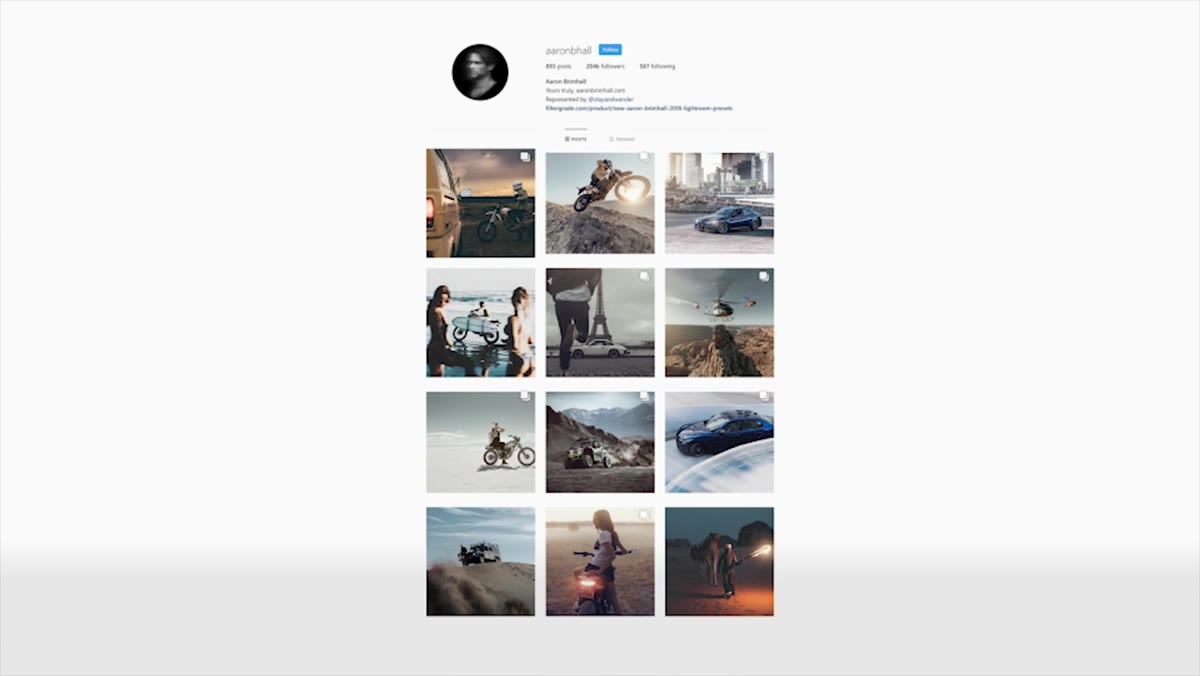
 Aaron Brimhall’s Instagram grid displayed on screen
McKinnon opens with Aaron Brimhall, and his first observation is the one worth writing down. Brimhall’s work is almost never static. Cars are actively moving, motorcycles are mid-wheelie, there is mud in the air. McKinnon points out that this commitment to motion over stillness is what separates the account from the dozens of automotive photographers who just park a beautiful car in a beautiful location and call it done.
The lesson here is practical. Next time you’re shooting anything with implied movement, ask whether you’re capturing the peak moment or the before-and-after stillness. A surfer standing on a board is a portrait. A surfer mid-carve with spray flying is an action photograph. The technical side means faster shutter speeds and a willingness to shoot a lot of frames to get the one where everything is happening at once. McKinnon also notes that Brimhall’s color toning is restrained. The edit serves the action without competing with it, which is worth noting if you tend to reach for heavy presets.
Step 2: Embrace Composite and Fantasy Photography - Visuals of Julius
 Julius’s composite photography grid shown on screen
The second account McKinnon highlights belongs to a visual artist who blends real photography with composited elements to create images that feel like they came from someone’s imagination. The moon might be impossibly large. A swing might be hanging somewhere it couldn’t logically exist. McKinnon is transparent that these aren’t straight captures and frames that honesty as part of what makes the account compelling.
What to take away here isn’t necessarily the compositing technique itself, though that’s worth learning if you’re interested. It’s the idea that your grid can have a consistent imaginative logic to it. Julius’s colors match across posts, the fantasy elements follow a consistent internal rule, and the result feels like a coherent world rather than a random collection of edited photos. If you’ve been treating each post as a standalone image, consider what would happen if you developed a visual world and committed to it.
Step 3: Document People and Street Life - Alex Strohl
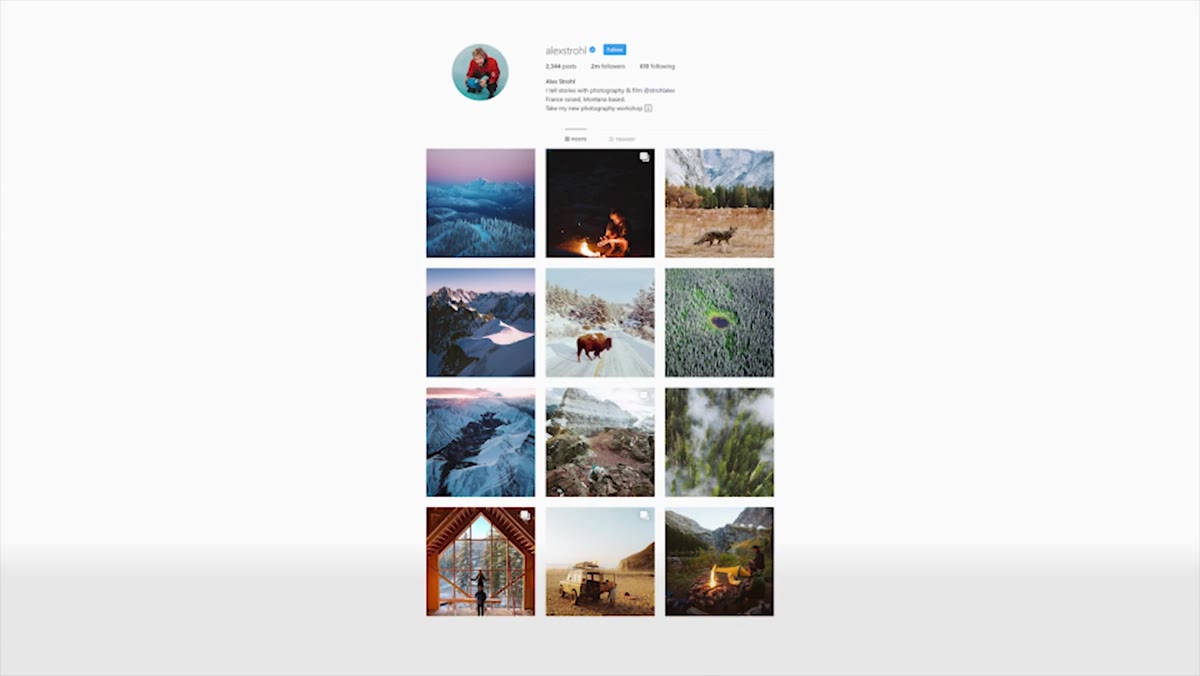 Alex Strohl’s Instagram profile being scrolled on screen
McKinnon describes Alex Strohl as one of the first photographers he ever followed, and credits him with being an early champion of a specific style: vast landscapes featuring small human figures. That compositional choice, putting a person inside an enormous environment rather than filling the frame with them, changed how a lot of photographers approach outdoor and adventure work.
The practical takeaway is about scale and context. When you’re shooting in a dramatic location, resist the instinct to separate your subject from the environment. Pull back. Let the mountains be enormous. Let the forest be overwhelming. The person in the frame becomes an anchor for the viewer, someone to identify with inside a world that feels almost too big. This works in travel photography, but also in urban environments where the architecture dwarfs your subject. Try it on your next shoot and see how it changes the emotional weight of your images.
Step 4: Learn From Photographers Who Break Your Own Genre Rules
 McKinnon reviewing photographers on his phone notes
One of the more useful things McKinnon does in this video, even if he doesn’t name it explicitly, is that his list crosses multiple genres. Automotive, fantasy composite, adventure, portraiture. He isn’t just following people who do what he does. He’s actively studying photographers whose work doesn’t overlap with his primary output.
This is a habit I’d push you to build deliberately. If you shoot portraits, spend time in the feeds of landscape photographers. If you shoot street, follow still life and product photographers. The techniques don’t transfer directly, but the compositional thinking does. I once borrowed a lighting approach from a food photographer I admired and used it to shoot window-lit portraits. That cross-genre borrowing is where a lot of original work comes from.
Step 5: Use Other People’s Grids as a Consistency Benchmark
 Scrolling through a cohesive Instagram photography grid
McKinnon keeps returning to how the accounts look as grids, not just as individual images. He notices when tones are consistent, when the visual energy of post after post holds up, when a grid looks great all the time. That’s a different standard than evaluating a single photo.
Pull up your own Instagram grid and squint at it. Not individual images. The whole thing. Does it look like it was made by one person with a clear point of view, or does it look like five different photographers sharing one account? Consistency doesn’t mean every photo looks identical. It means your editing choices, your color palette, your compositional instincts show up reliably. The photographers McKinnon admires most are consistent enough that you’d recognize their work without seeing their name attached.
A Note From My Own Experience: Inspiration Has an Expiration Date
Here’s the thing about curating an inspiration feed. It works until it doesn’t, and you have to refresh it. I went through a phase where I followed the same 20 accounts for two years and wondered why I felt creatively flat. The accounts hadn’t changed. I had just absorbed them completely and stopped being surprised. McKinnon’s list gave me three new accounts to study when I first watched this video, and that injection of unfamiliar work was enough to shift something.
Set a reminder every three to six months to actively go looking for photographers you’ve never heard of. Use the accounts you already love as a jumping-off point. See who they tag, who they collaborate with, who shows up in their comments. The goal is to stay in a mild state of creative discomfort, always looking at work that’s slightly outside what you currently know how to make.
The single most important thing McKinnon demonstrates here isn’t any one photographer. It’s the practice of maintaining a living list of people whose work makes you uncomfortable in the best way. Keep that list updated and return to it whenever your own work starts feeling predictable.
Watch the full tutorial on YouTube to see McKinnon walk through each account himself and get a look at the actual grids he’s referencing.
Comments
Leave a Comment